
What Are Arrays and Repeated Addition, and Why Do They Matter?

An array is just objects arranged in neat rows and columns. Think of a muffin tin or a carton of eggs. Once kids can see an array, they can count it two ways. They can count one square at a time. Or they can count it as equal groups added together. That second way is repeated addition.
This is the whole idea behind standard 2.OA.C.4. It asks second graders to find the total number of objects in a rectangular array. The array can have up to 5 rows and 5 columns. Students then write that total as an equation.
Here’s why this skill is worth slowing down for. Arrays are the visual model that makes multiplication click later on. A student who looks at 4 rows of 5 and says “5 plus 5 plus 5 plus 5” already understands what multiplication means. That happens long before anyone hands them a times table to memorize. Skipping straight to fact memorization skips this groundwork. Kids end up able to recite 4 x 5 = 20. But they freeze the moment a word problem asks them to picture what that looks like.
Arrays do double duty with 2.OA.C.3 too. Pairing objects into rows is one of the clearest ways to show whether a number is even or odd. A single set of array practice ends up reinforcing two standards at once. That overlap is part of why this skill shows up again and again, across worksheets, digital task cards, and self-grading assessments.
Worksheets: The No-Prep Foundation
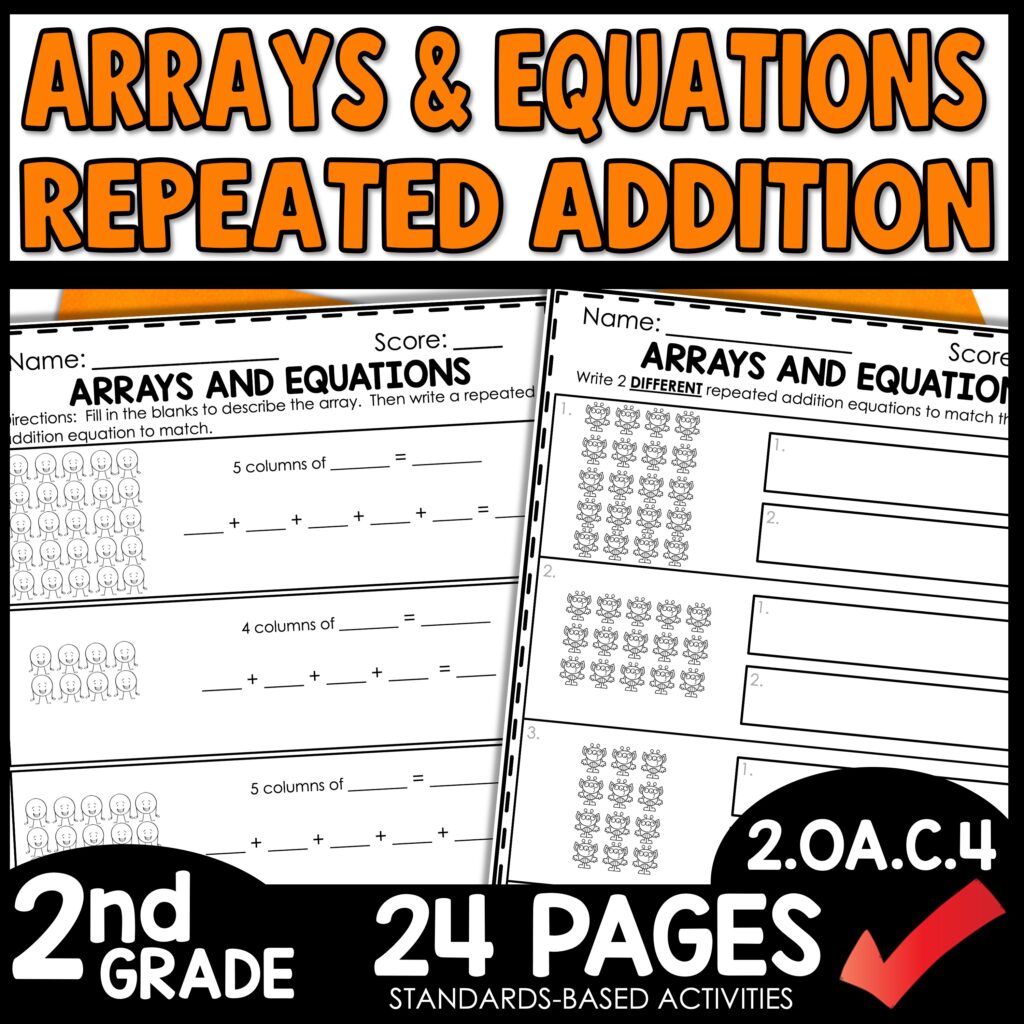
The Arrays & Repeated Addition 2nd Grade Math Worksheets set targets 2.OA.C.4 directly. It gives students practice on rectangular arrays up to 5 rows by 5 columns. Pages come in two versions. One has the standard printed at the top for easy record-keeping. One leaves it off for when you’d rather keep things simple. Every page comes with a full answer key. It’s an easy grab-and-go option for early finishers, a sub tub, RTI groups, or homeschool review. There’s genuinely no prep beyond hitting print.
For a broader practice set, try the Arrays and Repeated Addition Equal Groups Array Practice Worksheets packet. It folds in equal groups and even and odd numbers alongside arrays. That means it covers 2.OA.C.3 and 2.OA.C.4 together in one resource. It’s a good pick when you want students moving between all three related skills in a single sitting.
If arrays are just one piece of what you’re teaching this year, take a look at the year-long 2nd grade math bundle. It pairs arrays and repeated addition with place value, measurement, and multi-digit addition and subtraction. You won’t need to piece together separate resources module by module.
Boom Cards: Self-Checking Practice Kids Actually Want to Do
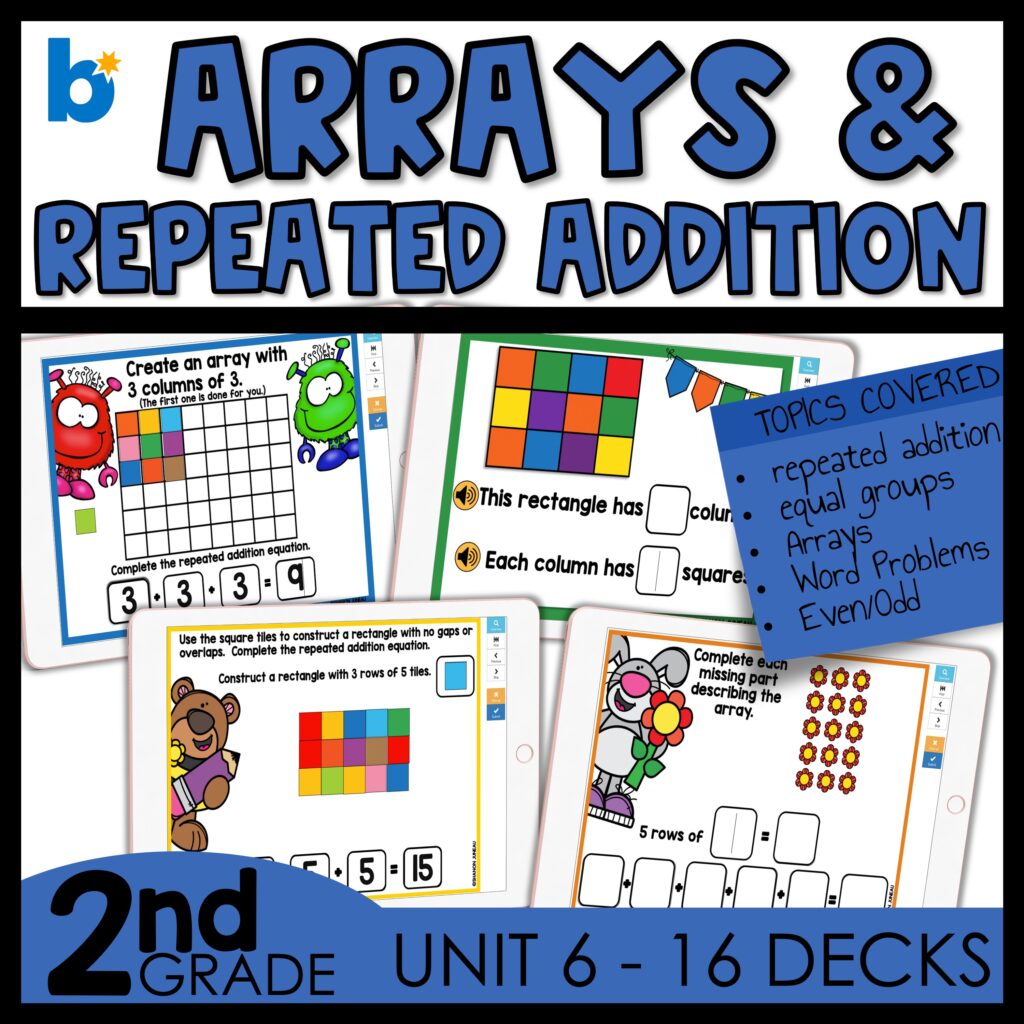
Boom Cards turn arrays practice into something students can do independently. Every deck grades itself and gives instant feedback. Rather than one giant deck trying to cover everything, this collection breaks the skill into small, focused decks. Each one builds on the last:
- Creating Arrays using Boom Cards: students drag squares into the array they’re asked to build. A great starting point before moving into equations.
- Arrays using Boom Cards: students read an array and identify the rows, columns, and total.
- Repeated Addition and Arrays using Boom Cards: students write the repeated addition equation. They also build the matching rectangle.
- Arrays 2nd Grade Equal Groups Boom Cards Math Games: a listening-and-counting format. Students find rows, columns, and totals from spoken directions.
- Arrays and Repeated Addition Boom Cards Task Cards Activities: a comprehensive review deck. It mixes repeated addition and array problems for continued practice.
- Arrays and Equal Groups Boom Cards Math Games: students drag images into rows and columns to build their own arrays from scratch.
- Repeated Addition with Arrays & Equal Groups Boom Cards Math Array Games: combines repeated addition equations with decomposing arrays into rows and columns.
- Even or Odd using Arrays with Boom Cards: students arrange objects into a 2-row array to decide even or odd. This ties the array model directly to 2.OA.C.3.
Want the whole progression at once? The Repeated Addition with Arrays and Equal Groups Boom Cards bundle brings the full set together. A one-click link adds every deck straight into your Boom Library. No hunting down individual purchases later.
Google Forms Assessments: No-Prep Digital Check-Ins
Sometimes you just need a quick, paperless way to see who’s got it. The Google Forms sets handle exactly that. Each one is self-grading, so results are ready the moment a student submits.
The Arrays and Repeated Addition Google Forms Assessment has students build an array. Then they find the matching repeated addition equation. The Arrays using Google Forms Assessment focuses on reading arrays up to 5 by 5. Students identify rows, columns, or totals. And Decomposing Arrays using Google Forms asks students to break an array apart by rows or by columns. That skill leads directly into the distributive thinking they’ll need for multiplication down the road.
These run through Google Drive, so they’re an easy fit for a quick formative check between lessons. They also work well as an exit ticket, or even for a sub day when you want something that grades itself.
Putting It All Together
Here’s a simple flow that works well for most classrooms. Start by introducing the concept with a worksheet or the “Creating Arrays” Boom deck, so students physically build arrays before anything else. Rotate through more Boom Cards decks during centers for independent, self-checking practice. Then use a Google Forms assessment as your formative check to see who’s ready to move on. Every format covers the same core standards, so you can mix and match based on what a particular day calls for. That might be paper for a sub, a screen for centers, or a quick digital check before the next lesson.
